
Blog
Low-Light Photography Tips for When the Sun Ditches You


Shooting after sunset or indoors in Pakistan can feel frustrating when the light disappears faster than you expect. Weddings, evening bazaars, street food stalls glowing under bulbs, or even family gatherings, these are the moments we love capturing. Still, low-light conditions often result in blurry, noisy, or dark photos. Don’t worry. With the right approach, you can still get sharp, beautiful images even when the sun sets.
Here are practical, tested low-light photography tips that actually work in real Pakistani scenarios.
Play with the Exposure Triangle in Low-Light Conditions
You’ve heard it a thousand times, but it matters more than ever in low-light photography:
- Wide Aperture (low f-number): f/1.4, f/1.8, or f/2.8 lenses let in way more light. A 50mm f/1.8 is still one of the most affordable and effective tools for photographers.
- Slower Shutter Speed: Anything slower than 1/60 sec risks camera shake unless you stabilize properly.
- Higher ISO: Yes, noise increases, but modern cameras control it surprisingly well. Don’t be afraid to push ISO 3200 to 6400 on newer bodies.
Best Camera Settings for Low Light
Here’s a solid baseline for most low-light photography settings:
- Mode: Manual or Aperture Priority
- Aperture: f/1.8 to f/2.8 (widest your lens allows)
- Shutter Speed: 1/60 sec (handheld) or slower if on tripod
- ISO: Auto with upper limit of 6400 to 12800 (depending on your camera)
- White Balance: Auto or Tungsten/Incandescent for warmer streetlights
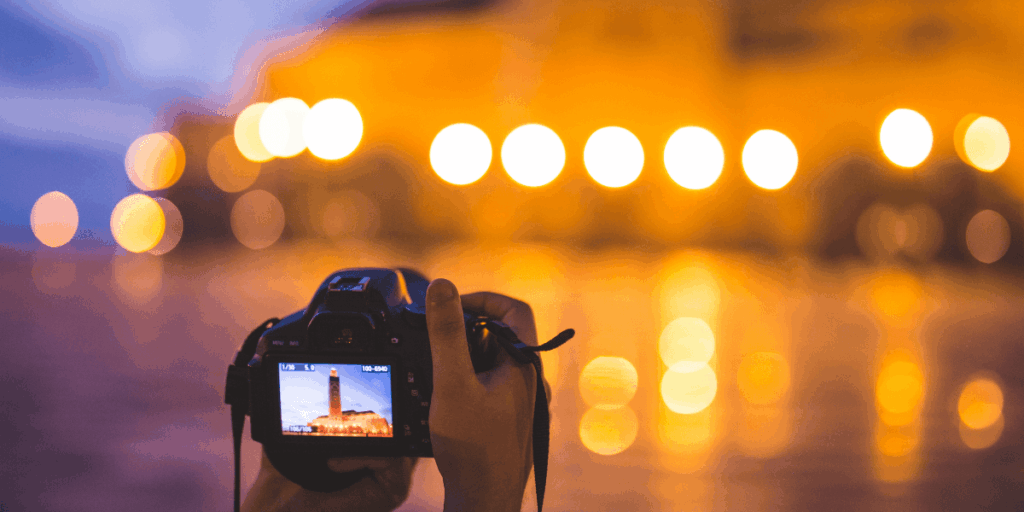
Tweak everything slightly to get the results you want for the scene.
Stabilize Like Your Life Depends On It
Nothing ruins a low-light shot faster than camera shake, which can cause blurriness and loss of detail. In Pakistan, users rarely carry tripods to a friend’s event or during late-night photography sessions, so learning alternative stabilization techniques is essential:
- Hold your camera with both hands, elbows tucked into your body.
- Lean against a wall, pole, or car if possible.
- Use image stabilization (IS/VR/IBIS). Turn it ON
- Enable the electronic first-curtain shutter or a fully electronic shutter to reduce shutter shock.
- If you shoot events regularly, invest in a small travel tripod or a monopod; they’re lifesavers for long exposures of city skylines or illuminated mosques.
Master Autofocus in the Dark
Low light is where cheap kit lenses fail miserably. Modern cameras with Dual Pixel or advanced phase-detection AF changed everything. The Canon EOS R6 Mark III mirror camera from Golden Camera, for instance, can lock focus in near darkness (-7 EV or lower). Tips that work on almost any camera:
- Use single-point AF and place it on the subject’s eye or face.
- Switch to back-button focus so you don’t lose focus when recomposing.
- Turn on AF-assist light if your camera or flash has it (just warn people first, it’s bright)
- If your camera struggles, switch to manual focus with focus peaking, which is surprisingly accurate on mirrorless screens.
Control and Embrace Noise
Noise isn’t always the enemy. A little grain can add mood to night street shots or concerts. But when it’s excessive:
- Exposure to the right (slightly brighter). Underexposed shadows amplify noise.
- Use in-camera noise reduction wisely (keep Long Exposure NR off if shooting bursts)
- Post-process with DxO PhotoLab, Topaz DeNoise AI, or Lightroom’s latest AI denoising; they work miracles now.
Use Available Light Creatively
Look for light sources instead of fighting the darkness:
- Neon signs flickering around you cast vibrant glows in the dusk, while car headlights streak across the wet road, creating streaks of light.
- Shop windows glow invitingly, fairy lights adorn wedding venues with warmth, and phone flashlights illuminate gatherings during load-shedding.
Move around, change angles, and let those light sources become part of your composition.
Shoot RAW
JPEGs look terrible when you try to recover shadows or pull details from dark areas. RAW files give you 2 to 3 extra stops of dynamic range. Storage is cheap now, no excuses.
Bonus Gear That Actually Helps
- Fast prime lenses like the 35mm f/1.8, 50mm f/1.4, and 85mm f/1.8 are crucial for capturing sharp, high-quality images with pleasing background blur.
- A sturdy yet lightweight carbon-fiber tripod under 20,000 PKR offers stability without added bulk, making it ideal for mobility.
- LED panel lights, such as the small Godox or Yongnuo models, offer versatile lighting options.
- Carrying extra batteries is crucial, especially during cold nights and when using high ISO settings, as they drain quickly and sustain your shoot reliability.
You can get the best price on lighting for studios in Pakistan from Golden Camera, with authentic warranties.
Understand How Your Camera Behaves in Low Light
Every camera responds differently to poor lighting conditions. Some handle noise gracefully, others lock focus in near darkness, and a few still deliver clean files even at sky-high ISOs. Getting to know exactly what your camera can (and can’t) do is the fundamental foundation of how to shoot in low light successfully.
Modern mirrorless bodies have entirely changed the game in this department, think faster autofocus, dramatically better high-ISO performance, and in-body stabilization that lets you hand-hold shots you’d never attempt before. The more time you spend understanding your specific gear’s strengths, the more confident you’ll become when the light disappears, and you need to capture sharp, beautiful images in tough low-light environments.
Final Thoughts
Low-light photography doesn’t need to be intimidating or overwhelming. Begin by mastering good techniques, such as controlling exposure and stability, and understanding your camera’s specific limits. Regular practice at local events, night markets, or outdoor settings will steadily improve your skills. The more consistently you shoot in challenging lighting conditions, the more your photography skills will grow, resulting in increasingly magical and captivating photos.