
Blog
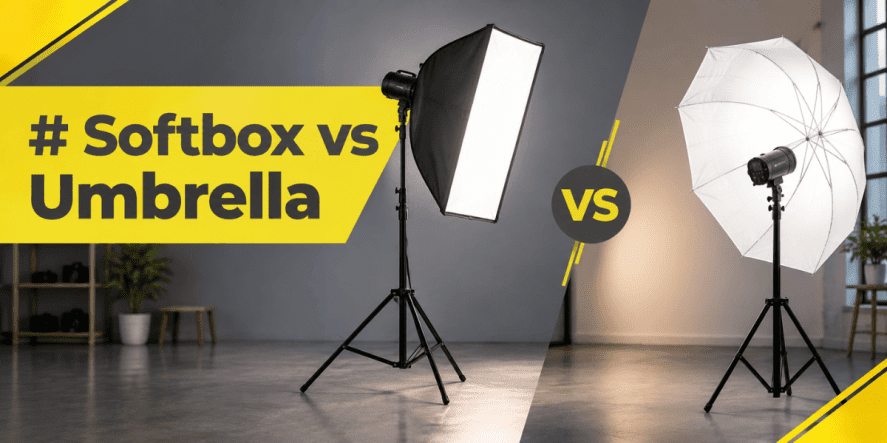
Softbox vs Umbrella: Which is Better for Studio Photography?

Published: 5 June 2025
Last updated: 18 Sept 2026
Zoom in on any studio portrait, and the eyes give away a secret. A small square or rectangle floating in the pupil means a softbox did the work. A soft, round glow means an umbrella did it instead. That tiny reflection can offer a useful clue about the light modifier used, and it has quietly settled the softbox vs. umbrella debate on thousands of shoots without anyone saying a word about it.
Photographers who can read that fingerprint already understand something beginners are still figuring out: the tool shapes the story of the photo before the shutter ever fires. Learning to see that difference is where real control over studio lighting begins.
What Is a Softbox and How Does It Shape Light?
A softbox is an enclosed lighting tool that wraps around a flash head, LED panel, or strobe and pushes the light through one or two layers of diffusion fabric before it reaches your subject. Reflective interior walls bounce stray light forward, so almost nothing spills to the sides or behind the unit. That enclosed design gives photographers tight control over where the light lands, which is why studio professionals reach for a softbox when they need repeatable, clean results.
Since light escapes only through the front panel, a softbox produces a focused beam with soft edges and minimal spill onto the background. This makes it a favorite for portrait sessions, food photography, and any setup where a clean, contained look matters.
Softboxes come in a handful of shapes, and the shape you pick changes the character of your light almost as much as the size does. Below are the main types worth knowing before you buy one.
1. Square and Rectangular Softboxes
Square and rectangular softboxes are widely available and enclosed on every side. This closed design makes them easy to set up and gives you soft, even light that resembles daylight passing through a window.
Photographers often use square boxes for headshots, while longer rectangular boxes can suit wider portrait shots. Both styles fold down small for storage, and a single unit paired with a diffuser panel handles most food and portrait work without any fuss.
2. Octagonal Softboxes for Round Catchlights
An octagonal softbox, often called an octa, has eight fabric panels that curve gently around the light source. That curve creates a smooth, gradual falloff across a face and leaves a round catchlight in the eyes that looks close to natural window light.
Wedding and beauty photographers often use octas because the round shape can flatter skin without looking overly flat. They work well for both single portraits and small group shots, and many models fold down almost as compactly as an umbrella.
3. Strip Softboxes for Edge Light
A strip softbox is a narrow, tall version of the rectangular design, built to throw a thin band of light along the edge of a subject. Photographers place them on either side of a model to separate the subject from the background.
Fashion photographers often use two strip boxes in a triangle formation to create a subtle rim light effect around the body. This narrow shape also works well for tabletop product shoots where you need a clean highlight running down the side of a bottle or a phone.
4. Parabolic Softboxes for a Bold Look
Among the most distinctive softbox types, a parabolic softbox has a deep, curved shape that lets you slide the light source forward or backward inside the unit. Moving the flash head changes the light’s contrast and punch without touching the stand or the angle.
This adjustability makes parabolic softboxes popular for editorial and beauty work where photographers want more drama than a standard octa delivers. They take a bit longer to set up, but the extra control is worth it for creative portrait sessions.
5. Lantern Softboxes for Soft Wraparound Light
A lantern softbox looks like an oversized paper lantern and sends light out in almost every direction rather than in one tight beam. That wraparound quality softens shadows on all sides of a subject at once.
Real estate and interior photographers like lantern softboxes because they fill a room evenly without harsh falloff in the corners. They also work nicely as a fill light behind a subject when you want a gentle glow rather than a hard rim.
Softbox Sizes and What They Change
Size plays a bigger role in light quality than most beginners expect. A large softbox held close to a subject spreads light across a wider angle, smoothing shadows and creating a gentler transition between light and dark areas.
A small softbox does the opposite. It behaves closer to a point source, so shadows appear sharper and contrast climbs. If you shoot full-length portraits or small groups, a larger box in the 90 to 170 centimeter range gives you more even coverage across the frame.
What Is an Umbrella and How Does It Spread Light?
An umbrella light modifier folds open like a rain umbrella, and photographers slide it onto a bracket that mounts to a light stand or flash unit. Unlike a softbox, an umbrella has no front diffusion panel enclosing the light, so it scatters illumination over a wide arc rather than aiming it in one direction.
That open design is exactly why beginners gravitate toward umbrellas first. No speed ring to assemble and no rods to thread through fabric sleeves. You open it, lock it onto the stand, and start shooting within a minute or two.
Shoot-Through Umbrellas for Gentle Diffusion
A shoot-through umbrella uses thin, translucent fabric, with the flash firing through it toward the subject. Light passes straight through the material, scattering in every direction as it travels forward.
This style produces soft, broad light, which can make it forgiving for beginners still learning to read shadows. The trade-off is less control over spill, since light also escapes to the sides and behind the umbrella itself. For this reason, at this early stage, an umbrella diffuser vs. softbox choice usually favors the umbrella for its lower learning curve.
1. Reflective Umbrellas for Extra Punch
A reflective umbrella has a reflective interior lining that may be silver, white, or gold. The flash points into the umbrella rather than through it, and the interior surface bounces the light back onto the subject.
Silver linings add contrast and a slightly crisper edge to shadows, while gold linings warm up skin tones for a golden, sunset-like glow. White linings sit somewhere in the middle, giving soft output with a touch more punch than a shoot-through design.
2. Deep or Parabolic Umbrellas for Even Coverage
A deep umbrella, sometimes marketed as a parabolic umbrella, has a more pronounced curve than a standard reflective model. That extra depth can help concentrate the light and provide more even coverage across a large group or set.
Photographers who need one modifier to cover several subjects at once, such as a family portrait or a small product table, often reach for a deep umbrella because the coverage stays even from edge to edge.
Difference Between Softbox and Umbrella: Key Points to Know
The core difference comes down to containment. A softbox traps light inside a fabric box and releases it through a single front panel, while an umbrella lets light bounce or pass through an open surface with far less restriction. That single design choice explains almost every other contrast between the two tools.
Directional control is where the gap shows up most clearly. A softbox lets you aim light precisely at a subject with barely any spill onto the walls or background, which matters in a small studio or when you are shooting against a colored backdrop. An umbrella vs. softbox lighting comparison on set almost always comes down to this trade-off: an umbrella spreads light everywhere in the room, which is fine for a quick headshot but tricky when you need a clean, controlled background.
Setup speed and cost tip the other way. Umbrellas snap open in seconds and typically cost less than a comparable softbox, which is why many starter lighting kits include umbrellas: they are simple and affordable. Softboxes take a little longer to assemble the first few times, and the added fabric, rods, and speed ring usually push the price higher.
Catchlights, the small reflection of the light source visible in a subject’s eyes, also differ between the two. Rectangular and octagonal softboxes leave a defined shape that photographers can control, while an umbrella typically leaves a round, sometimes less distinct catchlight because of its circular structure. Weighing an umbrella light vs. softbox setup often comes down to which of these small details matters more for the shot in front of you.
Softbox and Umbrella: Similarities and Differences
Some parts of these two modifiers overlap more than photographers expect, while others pull sharply apart, and this table lays both out in one place.
| Comparison | Similarities | Differences |
| Purpose | Both soften and diffuse light | A softbox gives tighter control, while an umbrella creates broader light |
| Light sources | Both work with speedlights, strobes, and LED panels | Mount compatibility can vary between a softbox and an umbrella |
| Distance | Moving either modifier closer generally creates softer light | The spread and intensity of the resulting light differ between the two |
| Storage | Both can fold down for easier storage | A softbox may need disassembly, while an umbrella folds open and closed in seconds |
| Setup | Both can be mounted on a light stand | A softbox needs rods and a speed ring, while an umbrella uses a simple bracket |
| Light control | Both can shape the quality of light | A softbox offers more directional control and less spill than an umbrella |
| Portability | Both are available in travel-friendly designs | Umbrellas are generally more compact and quicker to pack than softboxes |
| Catchlights | Both create visible catchlights in the eyes | A softbox often leaves a defined shape, while an umbrella leaves a softer, rounder one |
| Modifiers | Both can be used to shape and soften light | Softboxes generally accept more accessories, including grids, than umbrellas do |
| Outdoor use | Both can be used on location | Umbrellas are more vulnerable to wind than softboxes |
| Learning curve | Both become easier with practice | Umbrellas are generally quicker for beginners to pick up than softboxes |
| Best use | Both work for portraits and other subjects | Softboxes suit controlled lighting, while umbrellas suit quick, broad illumination |
Once you’ve weighed a softbox against an umbrella, the next real decision is which light source drives either one. Golden Camera’s guide on Choosing the Best Godox Light for Your Photography Needs picks up right where this comparison leaves off. Contact us today for lighting that matches your ambition!
The Debate of Softbox vs Umbrella in Product Photography
Product photography rewards precision, and a softbox usually wins because its contained light controls reflections, highlights edges, and keeps the background easier to manage.
Why Softboxes Suit Small Product Shoots
Softboxes give product photographers precise control for clean, consistent results.
- Directs light precisely without spilling onto the background or nearby walls.
- Works well with reflective items like jewelry, glass bottles, and electronics.
- Creates soft gradients across curved surfaces when positioned close to the product.
- Reduces unwanted glare on shiny packaging by containing the light.
- Gives better control over edge highlights and shadow depth.
When an Umbrella Still Works for Products
An umbrella works well when you need broad coverage, quick setup, and simple product lighting.
- Works well for flat-lay shots, larger items, or catalog work when speed matters more than precision.
- Covers clothing stacks or wide product displays quickly with its broad, even light spread.
- Suits budget-conscious sellers starting an online store with a simple, affordable lighting setup.
- Delivers decent results before you invest in more advanced lighting equipment.
- Makes quick product shoots easier when you need even lighting for several items.
Product shots live or die by consistency, starting with the light source behind your modifier. Golden Camera stocks LED panels for continuous lighting, giving photographers flexible options for controlled product photography. Get in touch today and give your products the spotlight they deserve!
Which One Should Beginners Choose?
New photographers generally get better, faster results with an umbrella. The open design forgives small placement mistakes, the setup takes almost no learning curve, and the lower price point means less risk while you figure out how light behaves in your space.
A shoot-through umbrella paired with a basic speedlight can cover portraits, small products, and casual video for a fraction of the cost of a full softbox kit. Testing a couple of softbox types later, once your budget allows, helps you figure out which shape best suits the work you shoot most often. Once you understand how distance and angle change your shadows, moving up to a softbox for more controlled work becomes a natural next step.
If your work leans toward product catalogs, branded content, or client portraits where consistency matters, it is worth budgeting for a softbox sooner rather than later. At that stage, the umbrella diffuser vs. softbox decision stops being about ease of use and starts being about the polish your final images need.
What Studio Lighting Data Shows About Modifier Demand
The market for photography lighting gear has grown steadily as more people shoot for online stores, social media, and home studios, not just professional sets. According to Verified Market Reports, the global photography lighting equipment market was valued at nearly $ 49.82 billion in 2025 and is projected to reach $ 65.32 billion by 2032, growing at a compound annual rate of roughly 3.8 percent.
That growth tracks closely with the rise of home-based content creators and small businesses shooting their own product photos, the same buyers who most often weigh a softbox against an umbrella before making their first lighting purchase.
Quick Tips for Getting the Best Results from Either Modifier
A few small habits make either tool perform noticeably better, no matter which one sits on your stand.
- Keep the modifier close to the subject for the softest, most even light
- Angle a softbox or umbrella slightly downward to avoid flat, head-on shadows
- Feather the edge of the light past the subject for a gentler falloff
- Use a black flag or foam board to block spill from an open umbrella
- Add a grid to a softbox when you need tighter control on a small set
- Watch gold-lined umbrellas around cooler skin tones, since they can push the color warm
- Test modifier distance before the shoot, not mid-session with a model waiting
- Add extra diffusion layers when lighting reflective products such as glass or metal
- Store fabric modifiers in their padded case to protect the rods and seams
- Pair either tool with a reflector to fill in shadows without adding another light
Frequently Asked Questions
1. What Is The Difference Between A Softbox And An Umbrella?
A softbox encloses the light source and releases it through a diffusion panel for tight, directional light. An umbrella has an open design that scatters light through or off its surface for a broader, less controlled spread. Softboxes come in several shapes, cost more, and take longer to set up, while umbrellas are faster and cheaper.
2. Is A Softbox Better Than An Umbrella For Studio Photography?
Neither modifier is universally better, since the right pick depends on your subject and setting. Softboxes suit portraits, products, and video that need precise control. Umbrellas suit quick shoots, tight budgets, and photographers still learning the basics of studio lighting.
3. Which Provides Softer And More Controlled Lighting?
Softboxes generally offer more controlled lighting because their enclosed design limits spill and lets you aim the beam precisely. Umbrellas can produce equally soft light, especially the shoot-through style, but that softness comes with less directional control and more light bouncing around the room.
4. Which Is Easier To Set Up And Use?
Umbrellas win on ease of use every time. They open in seconds, mount without a speed ring, and require almost no assembly. Softboxes need a few extra minutes to attach rods and a diffusion panel, though most modern kits have simplified this process considerably.
5. Should Beginners Choose A Softbox Or Umbrella?
Beginners usually do best starting with an umbrella. The lower cost, quick setup, and forgiving light spread make it easier to learn how distance and angle affect an image before investing in a softbox for more advanced, controlled work later on.
Final Thoughts
Neither modifier wins outright once you compare a softbox vs. an umbrella side by side, since the right choice always traces back to what you are shooting and how much control the scene demands. Softboxes reward photographers who need precision for products, portraits, and video. Umbrellas reward speed, affordability, and a shorter learning curve for beginners. Most working photographers end up owning both, reaching for whichever tool fits the shot in front of them that day.
The right tool always depends on the shot in front of you, so a versatile kit beats a single favorite every time. Golden Camera’s flash lighting range lets you freeze motion, control challenging light, and capture every detail with confidence. Shop with us today and never miss a moment again!