
Blog
Amaran Ray 60c vs Ray 120c: Which RGB Monolight Fits Your Studio?

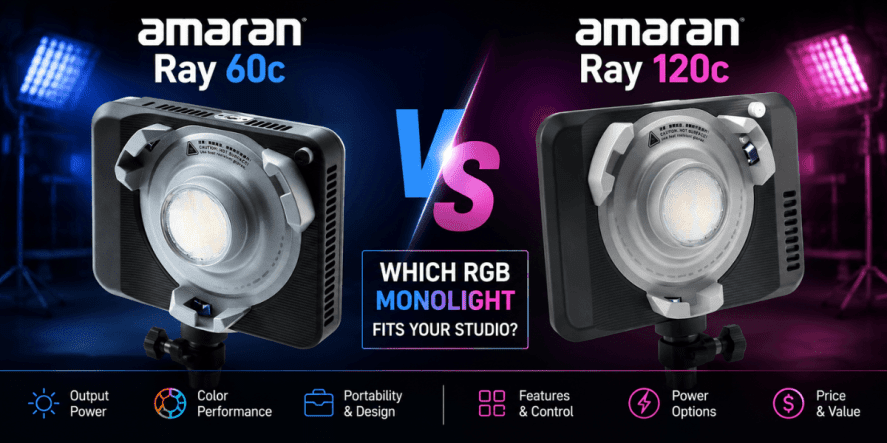
Full-color RGB lighting has moved from a creative luxury to a practical production standard. For creators, photographers, and videographers who need controllable, portable, color-accurate light without the bulk of traditional studio fixtures, compact COB monolights have become the go-to solution.
The Amaran Ray 60c vs 120c comparison sits at the center of this shift, offering two models that share the same design philosophy but differ meaningfully in output, power draw, and the types of setups each one handles best.
Both are part of Amaran’s new Ray series, introduced as a next-generation full-color COB lighting lineup alongside the company’s existing lighting ecosystem. Whether you are building a home studio, outfitting a mobile content setup, or looking for a compact key light for on-location video work, understanding the difference between both options is the starting point for making the right call.
The Rise of Compact RGB Studio Lighting
The demand for compact, controllable lighting has grown alongside the broader expansion of content creation and video production. According to Grand View Research, the global LED lighting market was valued at approximately USD 106.90 billion in 2025 and is expected to reach around USD 197 billion by 2033, expanding at a CAGR of 8.0% between 2026 and 2033.
A meaningful share of this growth is being driven by professional imaging, content creation, and video production, where demand for compact, high-output, controllable lighting solutions continues to expand.
For creators in Pakistan working across social media content, commercial photography, vlogging, and studio video production, having a reliable, portable, and color-accurate light source is no longer optional. The Ray series from Amaran is built specifically to meet this demand in a form factor that fits a backpack.
Amaran Ray 60c: Compact Full-Color Output for Creators on the Move
The Amaran Ray 60c is a 60W full-color COB LED monolight designed for creators who need professional-grade light quality in an ultra-portable form factor. At 4.4cm thin and weighing just 528g, it is one of the most compact COB lights available at this output level.
OmniColor Light Engine
The Ray 60c is powered by Amaran’s OmniColor light engine, which blends seven LED colors including an indigo emitter to deliver a fuller, more balanced spectrum than traditional three- or five-channel RGB systems. This results in cleaner whites, truer skin tones, and more accurate hue reproduction across the color wheel. Color accuracy ratings include CRI 95+, TLCI 95+, TM-30 Rg 100, TM-30 Rf 94, SSI Tungsten 87, and SSI D56 80, all strong indicators of professional-grade color fidelity.
Color Temperature Range and Modes
The Ray 60c covers a color temperature range of 2,300K to 10,000K, expandable to 1,800K to 20,000K in CCT+ mode, making it flexible across warm cinematic tones, neutral daylight, and cool high-color-temperature environments. Beyond CCT control, it offers 360-degree full-color control through HSI and RGB color modes, 12 built-in lighting effects including lightning, fire, TV flicker, strobe, and party lights, and a High-Speed Photography Mode that supports up to 240fps without flicker.
Output and Performance
The Ray 60c delivers up to 3,910 lux at 1 meter bare, which Amaran claims is 50% brighter than the previous-generation COB 60x S in the same wattage class. This output level handles small to medium studio setups comfortably, including solo content creation, product photography, interview setups, and smaller set pieces.
A 70-degree beam angle distributes light evenly across a scene, and full-size Bowens mount compatibility means the Ray 60c works with the complete range of Amaran softboxes, octaboxes, beauty dishes, fresnels, and grids available from Amaran and compatible third-party brands.
Power Options and Portability
The Ray 60c supports three power methods: the included DC power adapter, USB-C PD 3.0 input for powering from compatible power banks and chargers, and the Amaran Ace E-Lock system for wireless battery mounting. Using the optional Amaran Peak 75 battery, the Ray 60c runs for 46 minutes at 100% output, making it practical for battery-powered outdoor and on-location setups.
An IP54 rating provides dust and splash resistance for outdoor and location use, and an active cooling fan operates at a maximum of 28dBA in silent or smart fan mode, quiet enough to remain unobtrusive during video recording.
Unlock professional results with the most attractive Amaran Ray 60C price in Pakistan at Golden Camera. As Pakistan’s favorite camera destination, Golden Camera ensures authenticity and after-sales support as your creative journey deserves the best gear at the best price!
Amaran Ray 120c: More Output for Larger Setups and Demanding Environments
The Amaran Ray 120c shares the Ray 60c’s core architecture but delivers higher output in a body that is only slightly larger and heavier. At 5.1cm thin and weighing 599g, the Ray 120c remains genuinely portable while offering meaningfully more power for larger studio setups, multi-subject scenes, and environments where ambient light competes with the fixture.
OmniColor Engine at Higher Power
The Ray 120c uses the same OmniColor full-color light engine as the Ray 60c, delivering the same color accuracy specifications including CRI 95+, TLCI 95+, and matching SSI scores. The key difference is power draw: the Ray 120c consumes approximately 140W of actual power versus the Ray 60c’s approximately 85W, enabling higher lumen output that extends the light’s usable range and its effectiveness as a key light in brighter environments.
According to Newsshooter’s coverage of the Ray series launch, Amaran claims the Ray 120c delivers 22% more output than the previous Amaran 150c with nearly an 85% reduction in body size, a compelling case for creators who were previously working with larger, heavier fixtures in the same output range.
Color Temperature and Creative Modes
Like the 60c, the Ray 120c covers 2,300K to 10,000K in standard CCT mode and 1,800K to 20,000K in CCT+ mode, with green-magenta adjustment for fine-tuning color balance against mixed ambient light. HSI and RGB modes, 12 lighting effects, High-Speed Photography Mode up to 240fps, and Studio Mode are all available on both models, making the creative feature set identical regardless of which power level you choose.
Output and Studio Reach
The Ray 120c’s higher output makes it more suitable for scenarios where the 60c would need to be placed uncomfortably close to the subject to achieve adequate exposure. For setups with softboxes or large diffusion panels at medium distances, the 120c’s additional power gives more working room and allows the modifier to be positioned farther from the subject for softer, more even illumination.
For two-person interview setups, small group shoots, or any scenario requiring a key light that also functions as an effective fill or backlight at distance, the Ray 120c covers the range where the 60c would begin to fall short.
Power Options and Battery Runtime
The Ray 120c supports the same three power methods as the 60c: DC adapter, USB-C PD 3.0, and the Amaran Ace E-Lock battery system. At 100% output using the optional Amaran Peak 75 battery, the Ray 120c runs for 35 minutes, compared to 46 minutes for the 60c, reflecting the higher power draw at full brightness. Both runtimes extend significantly at reduced output levels.
The same IP54 weather resistance and 28dBA maximum fan noise apply to the 120c, maintaining the same suitability for outdoor and video recording environments.
Discover unbeatable value with the latest Amaran 120C price in Pakistan at Golden Camera. Perfect for studio and on-location shoots, this compact yet mighty light delivers cinematic quality. Golden Camera, your one-stop lighting destination in Pakistan, ensures authenticity and expert advice. Grab yours today and light up your creativity!
Shared Features Across Both Models
While the Amaran Ray 60c vs 120c specs comparison highlights output differences, both RGB monolights are built on the same platform and share several features that define the Ray series across the full lineup.
FlowTurn Knob and NFC Control
Both lights include Amaran’s FlowTurn knob, a physical rotary control that provides tactile feedback for adjusting brightness, color temperature, and color settings without needing a phone or app. For fast adjustments on set, this physical control is significantly faster than navigating an app interface.
Built-in NFC enables instant one-tap pairing to the Amaran app via a smartphone, which then provides full wireless control over all settings including HSI color mixing, lighting effects, and scene programs. Bluetooth connectivity handles ongoing wireless communication once the initial NFC pairing is complete.
Full-Size Bowens Mount
Despite the compact form factor of both lights, Amaran included a full-size Bowens mount on both the Ray 60c and 120c. This is a meaningful decision that preserves compatibility with the entire Amaran softbox and modifier ecosystem as well as a wide range of third-party Bowens-compatible accessories.
A 1/4-20-inch screw mount is also included for direct attachment to stands, grips, and mounting solutions without an adapter.
Included Kit
Both the Ray 60c and 120c ship as ready-to-shoot kits that include the Amaran Octa Dome 30 softbox with diffuser and grid for one-snap setup, an Ace Lock to Baby Pin Adapter Grip for quick mounting to light stands or handheld battery operation, a power adapter and cable, and a dedicated carrying bag.
This makes both lights immediately usable from the box without requiring separate modifier purchases.
Amaran Ray 60c vs 120c: A Comprehensive Overview
| Feature | Amaran Ray 60c | Amaran Ray 120c |
| Power Output | 60W (draws ~85W) | 120W (draws ~140W) |
| Max Output | 3,910 lux at 1m (bare) | Higher output at equivalent distance |
| Body Thickness | 4.4cm (1.7″) | 5.1cm (2″) |
| Weight | 528g (1.16 lb) | 599g (1.32 lb) |
| Color Engine | OmniColor (7 LED colors) | OmniColor (7 LED colors) |
| CRI / TLCI | 95+ / 95+ | 95+ / 95+ |
| CCT Range | 2,300K to 10,000K (1,800K to 20,000K CCT+) | 2,300K to 10,000K (1,800K to 20,000K CCT+) |
| Color Modes | HSI, RGB, 12 FX | HSI, RGB, 12 FX |
| High-Speed Mode | Up to 240fps flicker-free | Up to 240fps flicker-free |
| Battery Runtime (Peak 75) | 46 minutes at 100% | 35 minutes at 100% |
| Bowens Mount | Yes, full-size | Yes, full-size |
| USB-C PD Power | Yes | Yes |
| IP Rating | IP54 | IP54 |
| Fan Noise (Max) | 28dBA | 28dBA |
| Best For | Small studios, solo content, travel | Medium studios, multi-subject, location key light |
| Price Tier | Budget-friendly | Mid-range |
Is Amaran Ray 120c Worth It for Video Lighting?
The Amaran Ray 120c is worth considering for creators who need more power than a compact LED light can provide without moving into bulky studio fixtures. As a 120W RGBWW COB monolight, it delivers significantly higher output than the Ray 60c while keeping a portable design that works well for home studios, commercial shoots, interviews, and cinematic content creation.
For YouTubers, product photographers, interview creators, and independent filmmakers, the Ray 120c offers enough power to act as a reliable key light while remaining easier to transport than traditional studio fixtures. Its compact body, flexible power options, and app-based control make it practical for creators who frequently change locations or work in smaller spaces.
However, the Ray 120c may be more than you need if you mainly record simple talking-head videos in a small room or only require a soft fill light. In those situations, the Ray 60c can provide a more affordable and compact solution. The Ray 120c becomes the better choice when you need stronger output, more flexibility with modifiers, and a light that can handle more demanding production setups.
Which RGB Monolight Fits Your Studio?
Choosing the right RGB monolight depends on your studio needs, creative goals, shooting style, and the level of lighting control you require.
Choose the Amaran Ray 60c If You:
- Are building a home studio or compact solo content creation setup
- Work in small spaces where the light is positioned close to the subject
- Need maximum portability for travel and on-location shoots with battery power
- Are starting your first professional lighting kit and want a capable, affordable entry point
- Primarily shoot solo vlogs, product photography, or single-subject interviews
Choose the Amaran Ray 120c If You:
- Shoot in larger spaces where the key light needs to work at medium distances
- Record multi-person setups where the light needs to cover a wider area
- Need a stronger key light that can compete with ambient daylight in brighter environments
- Want more power reserve for using larger softboxes and diffusion modifiers at greater distances
- Produce commercial photography or video content where output consistency across a full scene matters
FAQs
1. What is the main difference between the Amaran Ray 60c and Ray 120c?
The primary difference is power output. The Ray 120c delivers roughly double the light output of the Ray 60c, making it better suited for larger studio setups, multi-subject scenes, and situations where more working distance between light and subject is required. The Ray 60c’s smaller size and 46-minute battery runtime make it the more portable and travel-friendly option. Both share identical color engines, creative modes, and app control capabilities.
2. Which RGB monolight is better for small studio setups?
The Amaran Ray 60c is the stronger choice for small studio setups. Its compact dimensions, lighter weight, and sufficient output for subjects at close to medium range make it well-matched to home studios, compact content creation spaces, and setups where the light is positioned within one to two meters of the subject. The Ray 120c’s additional output becomes more useful in larger rooms where that extra power is needed to maintain exposure quality at greater distances.
3. Does the Amaran Ray 120c provide significantly more brightness than the Ray 60c?
Yes. The Ray 120c’s actual power draw of approximately 140W versus the 60c’s 85W produces meaningfully more output at equivalent distances. Amaran states the 120c delivers 22% more output than the previous-generation 150c, which was already a step above the 60W class. For practical studio use, the 120c allows more working distance from the subject, more effective use of large modifiers, and better performance in bright ambient conditions where the 60c would begin to underpower.
4. Can both lights be controlled through a mobile app?
Yes. Both the Ray 60c and Ray 120c include built-in NFC for instant one-tap pairing with the Amaran app on iOS and Android, with Bluetooth handling ongoing wireless control. Through the app, users can adjust brightness, color temperature, HSI color mixing, RGB values, lighting effects, and access Studio Mode for more complex scene programming. Both lights also include the physical FlowTurn knob for direct on-light adjustments without a phone.
5. Which Amaran RGB monolight offers better value for money?
The answer depends on the studio size and use case. For small studio and solo content creation setups, the Ray 60c offers excellent value at a lower price point, delivering professional color accuracy and full RGB capability in the most portable form factor available. For creators who need more output for larger spaces or multi-subject shoots, the Ray 120c offers better cost efficiency than upgrading to larger fixtures in the 300W to 360W range while maintaining the same compact, travel-friendly design that defines the Ray series.
Closing Summary
The Amaran Ray 60c vs 120c decision comes down to how much output your specific setup requires. Both lights share the same OmniColor engine, color accuracy standards, control systems, Bowens mount compatibility, and portable design. The Ray 60c is the right choice for small studio and solo content setups where portability and budget are the primary considerations. The Ray 120c is the better investment for creators who need more light output to cover larger spaces, multi-person shoots, or on-location work where the key light needs more range.