
Blog
Canon R6 V vs Canon R6 II: Detailed Comparison

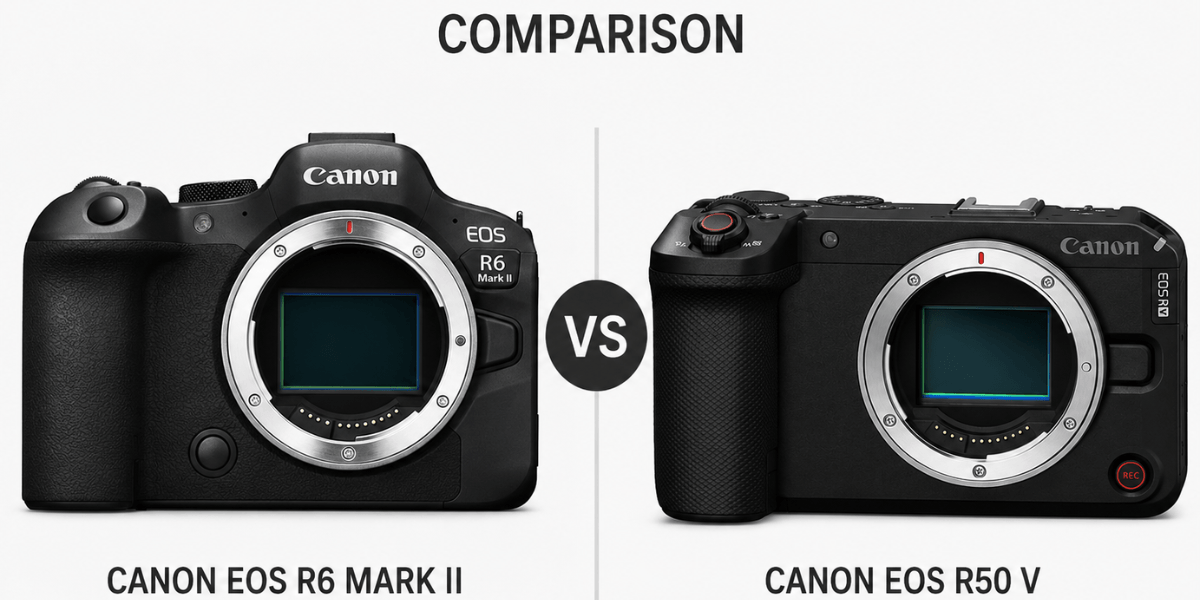
Canon’s R6 line has always been the accessible full-frame hybrid, the camera that gives serious creators professional image quality without the cost of the flagship R5. But in 2026, the line has split into two very different cameras that share a name and almost nothing else about their design philosophy.
The Canon R6 V vs Canon R6 II comparison is no longer simply about which model is newer. It is about choosing between a proven, well-rounded hybrid and a video-first specialist that represents a completely new direction for Canon’s creator lineup.
How Canon’s R6 Line Has Evolved
The Canon EOS R6 Mark II launched in November 2022 as an upgrade to the original R6. It brought a higher-resolution 24.2MP sensor, an improved autofocus system, better video features, and removed the 30-minute recording time limit that frustrated video creators using the original model. It remains one of the most capable and balanced hybrid cameras in its class.
The Canon EOS R6 V, announced in May 2026, takes a completely different approach. Rather than iterating on the hybrid formula, Canon built the R6 V as a video-first specialist within the EOS V series, a new product line aimed specifically at content creators and advanced videographers. It shares the 32.5MP sensor from the R6 Mark III but strips out the electronic viewfinder and mechanical shutter in favor of an active cooling system, vertical shooting support, and cinema-grade video specifications.
According to Canon’s official announcement, the R6 V is designed for creatives who capture video daily, with handheld and gimbal shooting as primary use cases. This positions it as a fundamentally different tool compared to the R6 Mark II’s balanced hybrid approach.
Canon R6 II Specs: The Proven Hybrid
The Canon R6 Mark II represents Canon’s most refined full-frame hybrid at the time of its launch and continues to hold up as an excellent all-around camera in 2026.
Sensor and Image Quality
The R6 Mark II uses a 24.2MP full-frame CMOS sensor with Canon’s DIGIC X image processor. While four megapixels more than the original R6, the resolution is still positioned for high-quality stills and video rather than pixel-count leadership. ISO range runs from 100 to 102,400, expandable to 204,800, with the camera’s low-light performance remaining exceptional for a 24MP full-frame body.
Autofocus
The R6 Mark II uses Canon’s Dual Pixel CMOS AF II system with improved subject detection powered by deep learning. The camera recognizes and tracks humans, animals (including horses, zebras, dogs, cats, and birds), and vehicles including airplanes and trains. An Auto subject detection mode eliminates the need to manually switch between subject types, and a Flexible AF mode inherited from the EOS R3 allows fine-grained control over where the camera prioritizes focus.
Video Capabilities
The R6 Mark II records 4K up to 60fps oversampled from 6K, with 10-bit 4:2:2 internal recording in Canon Log 3. The removal of the recording time limit was a major improvement over its predecessor. It also added focus breathing correction, a false color exposure aid, a 3-to-5-second pre-recording function, and a dedicated video quick control screen. Full HD slow motion is available at up to 120fps with autofocus support.
Body and Handling
The R6 Mark II retains the traditional mirrorless camera design with an electronic viewfinder, a fully articulating 3-inch touchscreen, dual SD card slots, and dedicated stills/video mode controls. It is a well-rounded body designed equally for photography and video, making it natural for photographers who also produce video content.
Make your next camera purchase count by checking the Canon R6 II price in Pakistan at Golden Camera. Enjoy genuine products, professional assistance, and a seamless shopping experience from a trusted camera specialist.
Canon R6 V Specs: The Video-First Specialist
The Canon EOS R6 V is a new type of camera for Canon. Announced in May 2026, it brings cinema-grade video specifications to a compact, gimbal-friendly body designed specifically for creators who prioritize video production above everything else.
Sensor and Processing
The R6 V is built around the same 32.5MP full-frame CMOS sensor used in the EOS R6 Mark III and the Cinema EOS C50, paired with the DIGIC X processor. This is a significant step up in resolution from the R6 Mark II’s 24.2MP sensor, and the larger pixel count enables higher-resolution video output with more detail retained in the final image. ISO range runs from 100 to 64,000, expandable to 50 to 102,400, with Canon claiming 15 or more stops of dynamic range in Canon Log 2.
Video Specifications
The R6 V’s video capabilities go well beyond the R6 Mark II. It records 7K 60p RAW internally to a CFexpress card, along with 7K 30p Open Gate RAW for full-sensor capture that can be reframed in post. Oversampled 4K at up to 60fps provides broadcast-quality footage, while uncropped 4K at 120fps delivers high-quality slow motion. 2K and Full HD are available at up to 180fps.
Color profiles include Canon Log 2 and Log 3, HLG, PQ, and Canon 709, with a dedicated color button for fast profile switching during a shoot. The camera also outputs uncompressed RAW over full-size HDMI for Apple ProRes RAW recording to external recorders including the Atomos Ninja series.
Active Cooling System
One of the most practically important features of the R6 V is its built-in active cooling fan. According to Canon’s official specifications, the R6 V is rated for up to six hours of continuous recording in 7K RAW Light, a dramatic improvement over the R6 Mark III, which would overheat and stop recording 7K video after approximately 20 to 25 minutes. For creators producing long-form content, live streams, or documentary work, this reliability is a significant operational advantage.
Body Design and Creator Features
The R6 V uses a flat, brick-style body with no electronic viewfinder and no mechanical shutter. This flat top plate is specifically designed to work well with camera cages and gimbal rigs. Creator-focused features include a vertical tripod mount for portrait-format shooting, a front-facing record button, a power zoom lever compatible with the new RF 20-50mm F4 L IS USM PZ lens, a tally lamp, and a full-size HDMI terminal.
In-body image stabilization is rated at up to 7.5 stops at center, coordinated with optical IS in compatible RF lenses for combined stabilization that makes handheld video shooting genuinely practical without a gimbal.
Find the latest Canon R6 V price in Pakistan at Golden Camera and invest in authentic Canon technology built for outstanding photography and video performance. Enjoy professional advice, competitive offers, and reliable customer service that helps you choose the right camera for your creative journey.
Canon R6 II vs R6 V Specs: Head-to-Head Comparison
| Feature | Canon R6 Mark II | Canon R6 V |
| Sensor | 24.2MP full-frame CMOS | 32.5MP full-frame CMOS |
| Processor | DIGIC X | DIGIC X |
| Max Video | 4K 60p (oversampled from 6K) | 7K 60p RAW, 7K 30p Open Gate |
| Internal Color Depth | 10-bit 4:2:2 | 10-bit 4:2:2 (XF-HEVC S/XF-AVC S) |
| 4K Slow Motion | FHD 120fps (AF) | 4K 120fps uncropped |
| Color Profiles | C-Log 3, HLG, PQ | C-Log 2, C-Log 3, HLG, PQ, Canon 709 |
| Active Cooling | No | Yes (2+ hours at 7K RAW) |
| Viewfinder (EVF) | Yes, 0.5″ 3.69M dot | No |
| Mechanical Shutter | Yes | No |
| Vertical Shooting Support | No | Yes (dedicated mount + UI) |
| IBIS | Up to 8 stops (coordinated) | Up to 7.5 stops (coordinated) |
| Body Price (USD) | Was $2,499 at launch | $2,499 |
| Best For | Stills and video hybrid | Video-first, creator content |
What Improvements Does the Canon R6 V Offer Over the Canon R6 II?
The answer to “what is the difference between Canon R6 and R6 Mark II?” reveals a clear generational leap in video capability. The R6 V brings a higher-resolution sensor, 7K RAW internal recording, 4K 120fps slow motion, an active cooling system for extended sessions, and a design specifically optimized for gimbal and handheld video production. For video creators, these are meaningful upgrades.
However, the R6 V also removes features that matter to photographers: there is no electronic viewfinder, no mechanical shutter, and limited flash support. As Fstoppers noted in their R6 lineup comparison, the R6 V is a specialist, and for the right shooter it is exactly what they have been waiting for, but for a photographer moving into video, the R6 Mark II or the R6 Mark III remains the more complete tool.
Is the Canon R6 II Worth Upgrading From R6?
For owners of the original Canon EOS R6, the R6 Mark II brought several meaningful improvements:
- Four additional megapixels
- Enhanced AI subject tracking with expanded subject recognition
- The removal of the 30-minute recording limit
- Canon Log 3
- Improved heat management
According to Mirrorless Comparison’s detailed review, the R6 Mark II is a more complete camera in nearly every area, with the only significant downsides being a slightly more limited buffer and a higher price than the original.
For R6 Mark II owners considering the R6 V, the decision is more nuanced. If video production is the primary workflow, the R6 V’s 7K RAW capability, active cooling, and creator-focused body design represent a genuine leap. If the work is split evenly between stills and video, the R6 Mark II remains the stronger all-around tool.
Which Canon R6 Version Is Better for Photography?
For photographers, the Canon R6 Mark II is the stronger choice without question. Its electronic viewfinder, mechanical shutter, and balanced handling make it the more natural camera for traditional still photography workflows.
The R6 V lacks both, which limits its utility for photographers who rely on a viewfinder for precise framing or who need a mechanical shutter for flash sync or shooting in environments with rolling shutter concerns.
For video-focused creators producing professional content, short-form social video, or long-form documentary work, the R6 V’s cinema-grade specifications and active cooling make it the significantly more capable tool for that specific type of work.
FAQs
1. What improvements does the Canon R6 V offer over the Canon R6 II?
The Canon R6 V offers a higher-resolution 32.5MP sensor versus the R6 Mark II’s 24.2MP, 7K 60p RAW internal recording versus 4K 60p, uncropped 4K 120fps slow motion versus Full HD 120fps, a built-in active cooling system for extended recording sessions, vertical shooting support with a dedicated tripod mount, and a creator-focused body design optimized for gimbal and handheld video work. The R6 V sacrifices the electronic viewfinder and mechanical shutter to achieve this video-first design.
2. How do the autofocus systems compare between the Canon R6 V and R6 II?
Both cameras use Canon’s Dual Pixel CMOS AF II system with deep learning subject detection and tracking. The R6 Mark II’s system covers humans, animals, birds, and vehicles with an Auto subject detection mode. The R6 V’s AF system is optimized specifically for video shooting with smooth focus transitions, and Canon states it has been tuned for the demands of continuous video recording. Both systems are excellent for tracking moving subjects across a wide range of conditions.
3. Which camera delivers better video recording capabilities?
The Canon R6 V delivers significantly better video specifications. It records 7K 60p RAW internally, compared to the R6 Mark II’s maximum of 4K 60p. The R6 V also offers 4K 120fps uncropped slow motion, 7K Open Gate recording for full-sensor capture, an active cooling system for two or more hours of continuous recording, and a flat body design optimized for gimbal rigs. For professional video production, the R6 V is the stronger tool by a substantial margin.
4. Is the Canon R6 V worth upgrading to from the Canon R6 II?
It depends entirely on the primary use case. For creators whose work is primarily video, especially long-form content, documentary work, or projects requiring 7K or RAW output, the R6 V is a compelling upgrade that brings genuine cinema-grade capabilities to a portable body. For photographers or hybrid shooters who need a viewfinder, mechanical shutter, and balanced stills performance, the R6 Mark II remains the more complete camera, and the R6 Mark III may be a more appropriate upgrade path.
5. Which camera is better for professional photography and content creation?
For professional photographers, the Canon R6 Mark II is the better choice because it includes an electronic viewfinder, mechanical shutter, and handling optimized for still photography workflows. For professional content creators focused primarily on video production, the Canon R6 V offers cinema-grade specifications, active cooling, and a creator-first body design that the R6 Mark II cannot match. The right answer depends on whether the primary output is stills, video, or a genuine equal split between the two.
Bottom Line
The Canon R6 V vs Canon R6 II is a comparison between two cameras that share a name but serve fundamentally different creative purposes. The Canon R6 Mark II remains one of the best balanced full-frame hybrid cameras available, offering excellent stills performance, strong video capabilities, and the handling of a traditional mirrorless camera.
The Canon R6 V is a video-first specialist that trades the viewfinder and mechanical shutter for 7K RAW, active cooling, and a creator-optimized body that performs exceptionally well on gimbals and in long-form video production.
Ready to take your photography or filmmaking to the next level? Explore Golden Camera’s range of genuine Canon cameras and accessories, backed by expert guidance, competitive pricing, and dependable after-sales support to help you choose the perfect gear for every creative project.