
Blog
Canon R50 V vs Sony ZV-E10: Which One’s Right for You?

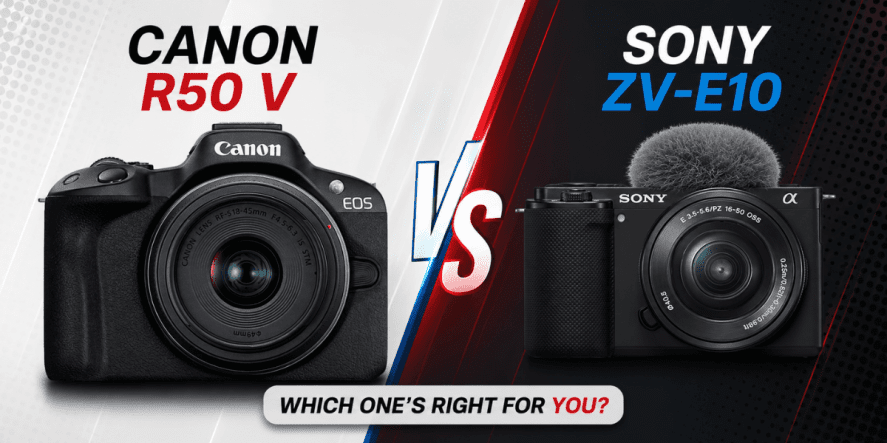
In Pakistan’s growing creator economy, short video content has become a major driver of online growth for small businesses, vloggers, and freelance editors. Cities like Karachi, Lahore, and Islamabad now see a steady rise in demand for compact cameras, especially among TikTok and YouTube Shorts creators.
The Growing Demand for Creator-Focused Cameras
The content creation industry has shifted the camera market in ways that were not anticipated even five years ago. According to Research and Markets, the global content creator economy was valued at USD 125.11 billion in 2024 and is projected to reach USD 160.91 billion in 2025, growing at a CAGR of 28.6%. This expansion has pushed both Canon and Sony to develop dedicated creator cameras that move beyond traditional mirrorless designs.
The result is a new category of interchangeable lens cameras built from the ground up for video-first creators, not as an afterthought, but as the primary design brief. Both the Canon EOS R50 V and the Sony ZV-E10 sit firmly in this category and represent the current best each brand offers at the entry-to-mid level for vloggers and social media creators.
Canon R50 V Specs: What You Are Getting
The Canon EOS R50 V was announced in March 2025 and launched in April 2025, making it the newer of the two cameras. It is Canon’s first interchangeable-lens camera built explicitly for vlogging and video-first creators, part of the EOS V series.
- Sensor and Image Processor
The R50 V is built around a 24.2MP APS-C CMOS sensor paired with Canon’s DIGIC X image processor, the same processor found in Canon’s higher-end bodies. It features a 1.6x crop factor with an ISO range of 100 to 32,000, expandable to 51,200 for low-light shooting.
2. Video Capabilities
This is where the Canon R50 V specs genuinely impress for a camera at its price point. It records UHD 4K at up to 60fps with 10-bit 4:2:2 color sampling in both XF-AVC S and XF-HEVC S formats. The standard 4K 30p mode is derived from full 6K sensor oversampling, which delivers noticeably sharper, more detailed footage. It also captures Full HD at up to 120fps for slow-motion sequences.
Borrowed directly from Canon’s Cinema EOS lineup, the R50 V includes Canon Log 3, HLG, PQ, and 709 recording profiles, giving editors significant grading latitude. The camera captures approximately 12 stops of dynamic range in C-Log 3 footage.
3. Design and Creator Features
The R50 V introduces a redesigned brick-style body that prioritizes vertical shooting and front-facing operation. Key creator-specific features include a front-facing record button, a secondary side-mounted tripod mount for vertical orientation, and a 3-inch fully articulating touchscreen. A tally light on the front confirms when recording is active, a practical addition for solo creators who cannot see the back screen while vlogging.
It also supports four live streaming modes: UVC via USB, HDMI streaming, Camera Connect app streaming, and Canon’s Live Switcher multi-camera streaming. A 3.5mm microphone input and multi-function accessory shoe with LPCM 24-bit four-channel audio support round out the audio capabilities.
4. Autofocus
The R50 V uses Canon’s Dual Pixel CMOS AF system with subject detection that covers humans, animals, and birds. It also includes Canon’s Register People Priority AF mode, previously reserved for the EOS R1, R3, and R5 Mark II, which allows users to register specific subjects for priority tracking across both video and stills.
Sony ZV-E10 Specs: What You Are Getting
The Sony ZV-E10 launched in 2021 as Sony’s first interchangeable-lens camera built specifically for vlogging, sharing the same core sensor as the Sony a6100.
- Sensor and Image Processor
The ZV-E10 uses a 24.2MP APS-C Exmor CMOS sensor, with a sensor area of 23.5 x 15.6mm, slightly larger than the Canon R50 V’s 22.3 x 14.9mm sensor. ISO range runs from 100 to 32,000, expandable to 50–51,200, which Camera Reviews notes gives it a slight edge in extreme low-light scenarios and shadow recovery.
2. Video Capabilities
The Sony ZV-E10 specs for video remain strong even years after launch. It records UHD 4K at 30 fps (with a slight crop) using full-pixel readout without pixel binning, and Full HD at up to 120 fps for slow motion. Internal recording supports 8-bit 4:2:0, with 10-bit 4:2:2 available via HDMI output to an external recorder.
The camera includes S-Log2, S-Log3, and HLG picture profiles for creators who want to grade their footage in post, along with Sony’s Background Defocus function, a single button that smoothly shifts between a blurred and sharp background, useful for transitions between talking-head and product shots.
3. Design and Creator Features
The ZV-E10 has a compact, lightweight body with a 3-inch fully articulating touchscreen, a built-in directional 3-capsule microphone, and a windscreen accessory included in the box, genuinely useful for outdoor vlogging. It also includes a tally lamp on the front to confirm recording status, and a Product Showcase mode that automatically shifts focus from the presenter’s face to an object held up to the camera, ideal for review and unboxing content.
4. Autofocus
The ZV-E10 uses a Fast Hybrid AF system with 425 phase-detection points, along with Sony’s proven Real-Time Eye AF for both humans and animals. Camera Reviews describes this tracking performance as among the best in its class, making it a long-standing favorite for vloggers, action shots, and pet content.
Canon R50 V vs Sony ZV-E10: Head-to-Head Comparison
| Feature | Canon EOS R50 V | Sony ZV-E10 |
| Sensor | 24.2MP APS-C CMOS | 24.2MP APS-C Exmor CMOS |
| Sensor Size | 22.3 x 14.9mm | 23.5 x 15.6mm |
| Processor | DIGIC X | BIONZ X |
| 4K Video | 4K 60p (cropped), 4K 30p oversampled | 4K 30p (slight crop) |
| Internal Color Depth | 10-bit 4:2:2 | 8-bit 4:2:0 (10-bit via HDMI) |
| Color Profiles | C-Log 3, HLG, PQ | S-Log2, S-Log3, HLG |
| Autofocus | Dual Pixel CMOS AF + Register People Priority | 425-point Fast Hybrid AF + Real-Time Eye AF |
| ISO Range | 100–32,000 (exp. 51,200) | 100–32,000 (exp. 50–51,200) |
| Built-in Mic | Standard stereo | Directional 3-capsule |
Sony ZV-E10 vs Canon R50: Video Quality Difference
For creators whose primary output is video, this is the most important section of the comparison.
The Canon R50 V has a clear generational advantage in raw video specifications. It’s 4K 60p with 10-bit 4:2:2 internal recording and 6K-oversampled 4K 30p mode, putting it well ahead of the ZV-E10’s 4K 30p with 8-bit 4:2:0 internal recording. If you need 60fps 4K, higher bit depth for grading, or built-in Log profiles without an external recorder, the R50 V is simply the more capable camera on paper, released roughly four years later with the technology to show for it.
The Sony ZV-E10 vs Canon R50 video quality comparison is not purely about specs. The ZV-E10’s slightly larger sensor area and Sony’s mature color science still produce excellent results for most online platforms, where 4K 30p remains the standard.
Camera Reviews notes that Sony’s marginal low-light advantage and Canon’s stronger color accuracy in certain interior scenes balance each other out for general stills use, but for video specifically, Canon’s newer sensor-and-processor combination gives it the edge in flexibility and image-quality ceiling.
For autofocus, both systems remain highly competitive even with the age gap. The ZV-E10’s 425-point Real-Time Eye AF is still considered class-leading for tracking consistency, while the R50 V’s Register People Priority AF gives it a practical advantage for creators who want the camera to remember and prioritize a specific subject across sessions.
In terms of color science, The Film Alliance’s Comparison notes that Canon produces stronger saturation and cleaner indoor color reproduction, while Sony’s output is more neutral and flexible in post-production. Canon’s colors tend to look polished straight out of the camera, which appeals to creators who want minimal grading. Sony’s footage rewards editors who prefer to shape the image themselves.
Which Camera Is Right for You?
Choosing between these two creator-focused cameras comes down to your shooting style, priorities, and long-term content goals.
Choose the Canon EOS R50 V If You:
- Want strong value at a significantly lower body price
- Shoot lifestyle, social media, or presenter-style content where Canon’s color science suits your output
- Plan to stream via multiple platforms and need built-in multi-cam support
- Want polished, ready-to-use footage with minimal post-production grading
- Are building into the Canon RF ecosystem long-term
Ready to upgrade your content game? Explore the latest Canon EOS R50 price in Pakistan and buy with confidence from Golden Camera, where genuine products, reliable support, and a smooth shopping experience come together.
Choose the Sony ZV-E10 If You:
- Want a proven, widely-used vlogging camera with years of community support and accessories
- Prioritize Sony’s class-leading Real-Time Eye AF for tracking subjects
- Need the widest possible lens selection at every budget level
- Are comfortable with 4K 30p for platforms like YouTube and Instagram
- Want a built-in directional microphone with an included windscreen for outdoor audio
Searching for the right balance of value and authenticity? Check the Sony ZV-E10 price in Pakistan at Golden Camera and bring home an original camera backed by trusted local support.
FAQs
1. Which camera is better for vlogging: Canon R50 V or Sony ZV-E10?
Canon R50 V suits users who prefer natural skin tones and simple operation. Sony ZV-E10 suits users who need faster autofocus and lens flexibility. Both support 4K recording, yet Sony performs better in movement-based vlogging scenarios, while Canon performs better in controlled indoor recording setups.
2. What are the key differences between Canon R50 V and Sony ZV-E10?
Canon focuses on color accuracy, guided interface, and smooth autofocus transitions. Sony focuses on sharper output, deeper customization, and a stronger lens ecosystem. Both share APS-C sensors, yet processing styles and usability design differ significantly between the two systems.
3. Which camera has better video quality and autofocus?
Sony ZV-E10 offers higher detail retention and stronger real-time tracking performance. Canon R50 V provides smoother tones and stable focus behavior. Autofocus strength depends on shooting style; Sony leads in motion tracking, while Canon delivers steady subject locking.
4. Is the Sony ZV-E10 worth it in 2026?
The Sony ZV-E10 remains relevant due to its strong lens support, reliable autofocus system, and consistent 4K output. It continues serving entry-level creators and remains widely used for YouTube, TikTok, and freelance video production workflows.
5. Which camera is more beginner-friendly?
Canon R50 V offers simpler controls, clearer menus, and smoother setup for first-time users. The Sony ZV-E10 offers more customization but requires more time to learn. Beginners often prefer Canon cameras for their straightforward handling and fewer configuration steps.
Closing Summary
The Canon R50 V vs Sony ZV-E10 decision comes down to how much weight you place on the newest video specifications versus a proven, well-supported system. The Canon R50 V is the more technically advanced camera in 2026, offering 4K 60p, internal 10-bit recording, and built-in Log profiles. The Sony ZV-E10 remains a dependable, capable choice with class-leading autofocus and one of the most extensive lens ecosystems available.
Both cameras are strong picks for content creation in 2025 and 2026. The right choice depends on whether your priority is cutting-edge video specs or a proven system with broader long-term flexibility. Planning your first mirrorless upgrade? Let Golden Camera help you make a confident choice with genuine stock and trusted service.