
Blog
DJI Osmo Nano vs Action Cameras: Which Is Better

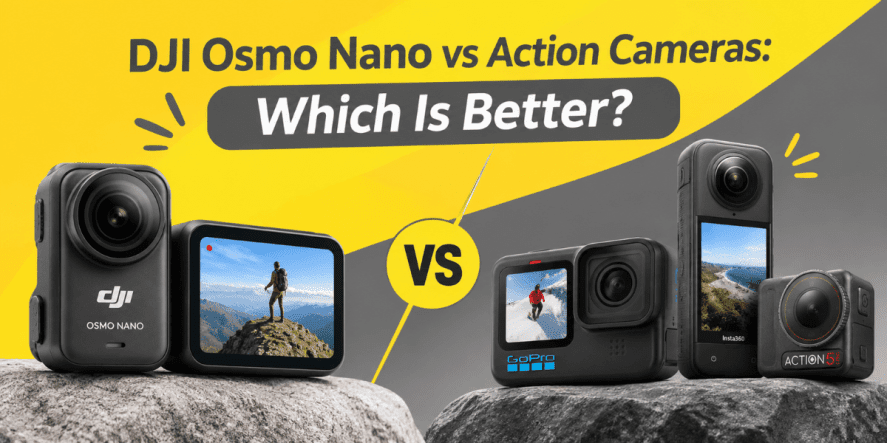
Planning a trip or a vlogging project can leave you stuck between a tiny wearable camera and a traditional action camera. Both promise sharp, steady video, yet they suit different habits. If you feel unsure, that is completely normal. This comparison explains the real differences in simple terms so you can decide with confidence.
Understanding the Difference Between a Compact Camera and an Action Camera
A compact camera is a small, point-and-shoot style device built for everyday photos and video. Some models use larger sensors that help in dim conditions, although they are generally less rugged.
An action camera is a compact, tough device built for high-motion recording. It offers a wide-angle view, strong stabilization, and mounting options that suit running, cycling, water activities, and travel walks. The table below summarizes the main differences.
| Feature | Compact Camera | Action Camera |
| Build | Lighter duty, needs care in harsh conditions | Rugged, made for knocks and weather |
| Lens | Standard view, often with zoom | Wide-angle view |
| Stabilization | Varies by model | Strong electronic stabilization |
| Low light | Often better on larger-sensor models | Usually weaker than larger-sensor cameras |
| Mounting | Handheld or tripod | Clips, magnets, and helmet mounts |
| Best for | Photos and general video | Movement and point-of-view footage |
How Do Action Cameras Work?
An action camera uses a small sensor and a wide-angle lens to capture a large part of the scene. It then applies electronic stabilization, which processes the footage to reduce shake caused by walking, running, or riding.
Wide-Angle Capture
The wide view keeps more of your surroundings in the frame, which feels immersive for travel and point-of-view clips. The Osmo Nano offers a 143-degree field of view with an f/2.8 aperture.
Electronic Stabilization
DJI’s RockSteady 3.0 electronic image stabilization reduces camera shake during supported recording modes. HorizonBalancing can help keep the horizon level in compatible settings. However, electronic stabilization is unavailable in slow-motion and time-lapse modes, so check the supported settings if smooth footage is a priority.
Key Features of the DJI Osmo Nano
The Osmo Nano takes a different path from conventional action cameras. It is a tiny wearable camera that works with a separate Vision Dock, which adds a touchscreen and extra battery life.
Size and Weight
The camera body weighs about 52 g, and the dock adds roughly 72 g. Together, they total 124 g, lighter than the 146 g Osmo Action 5 Pro.
Image Quality
The Osmo Nano uses a 1/1.3-inch sensor and records standard 4K video at up to 60 fps. It also supports 4K/120 fps slow-motion recording, which is useful for slowing down action and movement. Keep in mind that some features, including electronic stabilization, are unavailable in slow-motion mode.
Magnetic Mounting
Dual-sided magnets let you attach the camera to a hat clip, lanyard, or other mounts in seconds. That makes hands-free shooting simple during walks, markets, and family outings.
Battery and Dock
The camera alone offers about 90 minutes of recording, while the dock extends it to up to 200 minutes under DJI’s 1080p test conditions. Real results vary with resolution and temperature.
Water Resistance
The Osmo Nano camera is waterproof to a depth of 10 meters without additional housing, provided it is prepared according to DJI’s instructions. The Vision Dock is rated IPX4 for splash resistance and must not be submerged. Check the lens cover and follow the manufacturer’s underwater-use guidance before taking the camera into the water.
DJI Osmo Nano vs Larger Action Cameras
The Osmo Nano and Osmo Action 5 Pro both use 1/1.3-inch sensors, but their designs serve different recording styles. The Nano prioritizes wearable, hands-free capture, while the Action 5 Pro offers a conventional camera body with front and rear screens and a wider 155-degree field of view compared with the Nano’s 143 degrees. Actual image quality depends on shooting conditions and settings. The real difference is size and design, as the table shows.
| Feature | DJI Osmo Nano | DJI Osmo Action 5 Pro |
| Weight | 52 g camera, 124 g with dock | 146 g |
| Sensor | 1/1.3-inch | 1/1.3-inch |
| Field of view | 143 degrees | 155 degrees |
| Screen | 1.96-inch dock touchscreen | Dual screens |
| Video | 4K/60 and 4K/120 slow motion | 4K up to 120 fps |
| Mounting | Dual-sided magnets | Magnetic quick-release system |
If you like built-in front and rear screens and a traditional body, a larger action camera feels familiar. If weight and wearability matter more, the Nano makes a strong case.
What to Consider When Buying an Action Camera
Specifications can feel overwhelming, so focus on the details that affect your footage every day.
Image Quality and Low Light
Sensor size, dynamic range, and color options shape how your video looks. Action cameras generally struggle in dim conditions compared with larger-sensor cameras, so check for night modes and noise reduction.
Battery, Storage, and Durability
Check real battery life, storage options, and water resistance before you buy. Longer trips need spare batteries or a reliable charging plan, particularly in areas with limited power access.
Audio Quality
Built-in microphones are usually modest. Look for external microphone support, since clear voice recording matters for vlogs and interviews.
Are Action Cameras Good for Vlogging?
Yes, action cameras are a popular vlogging choice thanks to their wide field of view, strong stabilization, and portability. They work well for walking vlogs, travel diaries, and hands-free recording.
There are limits to consider. Low-light performance is weaker than larger-sensor cameras, and built-in audio improves with an external microphone. The Osmo Nano camera also has no front screen, so you’ll rely on the dock or your phone through the DJI Mimo app for framing.
For lightweight, hands-free recording, the DJI Osmo Nano On-the-Go Combo at Golden Camera is a lightweight option.
How to Choose a Camera for Travel Videos
Start with weight, because you will carry the camera all day. Next, consider stabilization, battery life, and how quickly you can start recording. A camera that fits easily in your pocket gets used far more often than one left in the bag.
Choose the Osmo Nano If
Pick the Osmo Nano when you value lightweight, wearable shooting, and quick mounting. It suits city walks, markets, and trips where you want minimal gear.
Choose a Larger Action Camera If
A larger model suits you better when you want built-in screens, a wider field of view, and a more traditional grip. It feels familiar for rougher adventures such as trekking in northern Pakistan.
FAQs
1. Is the DJI Osmo Nano waterproof?
The camera is waterproof to 10 m without a case. The Vision Dock is only IPX4 rated, so protect it from heavy water exposure.
2. Does the Osmo Nano record in 4K?
Yes, it records 4K at up to 60 fps and offers 4K at 120 fps for slow motion. It also supports 10-bit D-Log M color for editing flexibility.
3. How long does the battery last?
DJI lists about 90 minutes for the camera alone and up to 200 minutes with the dock in 1080p test conditions. Your results will vary with settings.
4. an I use an action camera instead of a compact camera?
Yes, when your priorities are movement, durability, and wide footage. A compact camera may suit you better if you want stronger low-light results.
5. Does the Osmo Nano have built-in storage?
Yes. The Osmo Nano comes in 64 GB and 128 GB versions. It also supports transferring footage to a microSD card through the Vision Dock, but it does not record directly to that card. Choose your storage capacity based on how often you record and how regularly you can transfer or delete files.
Final Thoughts
No single option is best for everyone. The DJI Osmo Nano excels in weight and hands-free mounting, while larger action cameras offer familiar screens and a wider view. Think about how you travel, what you record most often, and how much gear you are comfortable carrying. That clarity will lead you to the right choice, and it is perfectly fine to take your time.
Explore the latest action cameras at Golden Camera and find the model that fits your journey.