
Blog
Sony A7R VI vs Sony A7R IV: Is the Upgrade Worth It?

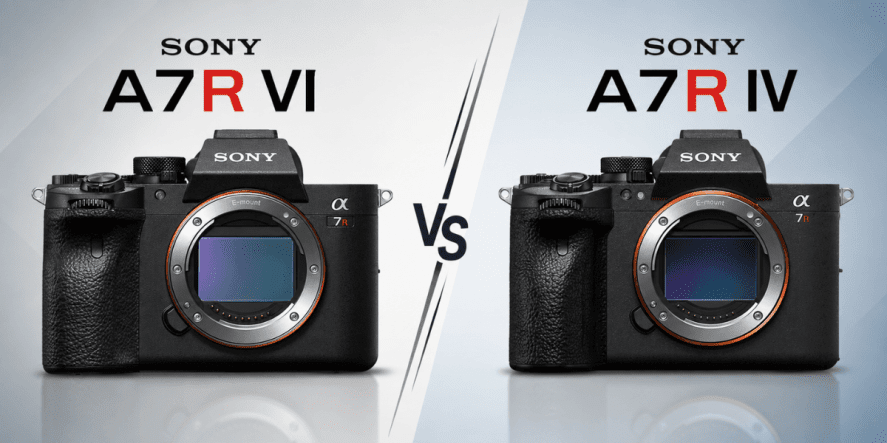
Sony’s A7R series has always stood for one thing above all else: resolution. Since the original A7R set a new benchmark for full-frame pixel count, each generation has pushed further, not just in megapixels but in the supporting technology that allows that resolution to be used across a broader range of shooting conditions.
The Sony A7R VI vs Sony A7R IV comparison spans seven years of sensor engineering, AI processing, stabilization, and video capability development. The A7R IV launched in 2019 as the world’s first 61MP full-frame camera and set a standard that held for several years. The A7R VI, announced in 2026, is a completely different type of camera built around the same high-resolution philosophy but with a stacked sensor, a new processor, and capabilities that blur the boundary between the R-series and Sony’s professional sports cameras.
This guide covers the differences between both options to help you decide which Sony A7R camera you should choose for your specific work.
The State of High-Resolution Photography in 2026
High-resolution cameras have moved from being niche studio tools to mainstream professional instruments across landscape, commercial, editorial, and even wildlife photography. The demand for detail that can withstand heavy cropping, large print output, and multi-platform commercial licensing has never been higher.
According to TechRadar’s review of the Sony A7R VI, the A7R VI resolves more detail than the 50MP sensor in the Sony A1 II, Sony’s previous flagship, while delivering most of that camera’s speed. This positions the A7R VI not just as a resolution leader but as a genuinely fast camera capable of serving use cases that previously required a dedicated sports body.
For photographers in Pakistan working across commercial photography, landscape, portraiture, and editorial work, understanding where the A7R IV still performs competitively and where the A7R VI represents a meaningful leap is the foundation of a smart purchasing decision.
Sony A7R IV Specs: The 61MP Pioneer
The Sony A7R IV launched in July 2019 as the first full-frame mirrorless camera to offer 61 megapixels of resolution. That specification alone defined the high-resolution category for several years and established the A7R IV as the benchmark for detail-oriented photographers across multiple genres.
Sensor and Image Quality
The A7R IV uses a 61MP BSI CMOS full-frame sensor without an anti-aliasing filter to maximize sharpness. This sensor produces exceptional detail in controlled shooting conditions, with the resolution providing significant room for cropping, large-format printing, and multi-use licensing. ISO range runs from 100 to 32,000 natively, expandable to 50 to 102,400.
At base ISO, image quality is outstanding. The camera also features Pixel Shift Multi Shooting, which composites multiple exposures into a single approximately 240.8MP image for even greater detail in static subjects, useful for commercial product photography and fine art reproduction.
Autofocus
The A7R IV uses Sony’s Real-time Eye AF and Lock-on AF with 567 phase-detection AF points covering 74% of the image frame. Subject detection covers humans and animals with real-time eye tracking for portraits and pet photography. At the time of its launch, this was among the strongest AF systems available. By 2026 standards, it remains capable for most portrait, landscape, and commercial work but shows its age against moving subjects and in challenging tracking scenarios.
Image Stabilization
The A7R IV includes Sony’s 5-axis in-body image stabilization rated at 5.5 stops of compensation. This was competitive at launch but has since been surpassed by newer generations. For handheld shooting in controlled environments, 5.5 stops is sufficient for the majority of still photography. For video or handheld shooting in challenging conditions, the limitation becomes more noticeable.
Video
The A7R IV records 4K video up to 30fps oversampled from 7K for excellent detail, and 4K 60fps in Super 35 crop mode. Internal recording supports 8-bit 4:2:0, with 10-bit 4:2:2 output available via HDMI to an external recorder. It does not support internal 10-bit recording, which is a limitation relative to cameras released in subsequent years.
Discover the latest Sony A7R IV price in Pakistan at Golden Camera and bring home a 61MP full-frame mirrorless camera built for incredible detail, professional photography, and high-resolution image creation.
Sony A7R VI Specs: Resolution Accelerated
The Sony A7R VI was announced in 2026 and represents the most significant architectural change in the A7R series since the original model. Rather than simply increasing megapixels further, Sony introduced a fully stacked CMOS sensor, a next-generation processor with integrated AI, and performance specifications that overlap with the company’s professional sports cameras.
Stacked 66.8MP Sensor
The A7R VI is built around a 66.8MP fully stacked Exmor RS BSI full-frame sensor, the highest resolution full-frame stacked sensor available in any camera at launch. The stacked architecture enables sensor readout approximately 5.6 times faster than the A7R V, enabling blackout-free continuous shooting at up to 30fps and significantly reduced rolling shutter compared to previous A7R models.
Dynamic range is rated at up to 16 stops for stills, with CineD’s lab test measuring approximately 14 stops in real-world video conditions. A copper wiring layer in the sensor improves data transmission speed for faster, cleaner 14-bit RAW capture.
BIONZ XR2 Processor with Integrated AI
The A7R VI uses Sony’s new BIONZ XR2 processor, which integrates the AI processing unit directly onto the same chip rather than using a separate AI processor as in the A7R V. According to Sony’s product documentation, this architectural change allows faster communication between subject recognition and autofocus, resulting in more responsive tracking and more stable subject lock in fast-moving or complex scenarios.
Autofocus: Real-time Recognition AF+
The A7R VI features Sony’s Real-time Recognition AF+ system with 759 phase-detection points covering 94% of the full-frame area, up from 567 points at 74% coverage in the A7R IV. AF sensitivity extends to -6 EV, and subject detection covers seven selectable types: human, animal, bird, animal/bird combined, insect, car/train, and airplane. Pre-Capture mode, new to the R-series, begins buffering at 30fps on a half-press of the shutter button so that action before the full press is preserved.
TechRadar’s review describes the autofocus as performing at a level that narrows the gap with the A1 II, Sony’s previous pro sports camera, making the A7R VI genuinely practical for wildlife and action photography in ways previous A7R bodies were not.
Image Stabilization
The A7R VI’s IBIS system is rated at 8.5 stops of compensation, up from 5.5 stops in the A7R IV. This improvement is partly enabled by the stacked sensor’s faster readout, which allows the stabilization system to make corrections more precisely and at higher speeds. A half-stop additional performance over the A7R V also represents incremental but meaningful progress for handheld telephoto and slow-shutter work.
Video Capabilities
The A7R VI marks the biggest video upgrade in the A7R series. It records 8K 30p internally via 8.2K oversampling with 10-bit 4:2:2, along with 4K 120fps from 5K oversampling and 4K 60fps in Super 35 from 6.3K oversampling. Internal recording is 10-bit, a significant improvement over the A7R IV’s 8-bit internal recording. ProRes RAW output is available over HDMI for compatible external recorders.
Color profiles include S-Log2, S-Log3, S-Cinetone, and HLG. The A7R VI is the first R-series body to support Sony’s Camera Authenticity Solution, including the C2PA standard for content provenance verification, which is increasingly relevant for photojournalists and editorial photographers.
Explore the Sony A7R VI price in Pakistan at Golden Camera to see current availability and compare it against the A7R IV for your specific workflow.
Sony A7R IV vs VI: Detailed Differences
| Feature | Sony A7R IV | Sony A7R VI |
| Sensor | 61MP BSI CMOS | 66.8MP Stacked Exmor RS BSI |
| Sensor Readout Speed | Standard | 5.6x faster than A7R V |
| Processor | BIONZ X | BIONZ XR2 (integrated AI) |
| AF Points | 567 (74% coverage) | 759 (94% coverage) |
| AF Subject Types | Human, Animal | Human, Animal, Bird, Insect, Car, Airplane |
| IBIS Rating | 5.5 stops | 8.5 stops |
| Max Burst (Electronic) | 7fps (12-bit RAW) | 30fps (14-bit RAW, blackout-free) |
| Internal Video | 4K 30p (8-bit 4:2:0) | 8K 30p (10-bit 4:2:2) |
| 4K Slow Motion | 4K 60p (Super 35, external) | 4K 120p (oversampled, internal) |
| Dynamic Range (Stills) | ~15 stops | Up to 16 stops |
| Card Slots | Dual SD UHS-II | Dual SD UHS-II or CFexpress Type A |
| Price Tier | Mid-premium (now reduced) | Premium flagship |
Sony A7R IV vs VI: The Real-World Differences That Matter
The comparison between Sony A7R IV and VI highlights key improvements, helping photographers understand performance, features, and real-world differences before choosing their ideal camera.
Resolution and Detail
The jump from 61MP to 66.8MP is meaningful but not dramatic in absolute pixel count. The more significant difference is in how those pixels are captured. The stacked sensor in the A7R VI reads data 5.6 times faster than the A7R V, which reduces rolling shutter, enables faster continuous shooting, and improves the overall responsiveness of the camera in ways that affect every shooting scenario, not just fast action.
For static subjects in controlled conditions, both cameras produce excellent results. The A7R VI’s advantage becomes most visible in challenging scenarios: moving subjects, handheld shooting, and situations requiring quick sequential captures.
Speed and Sports Capability
The A7R IV’s burst rate in 12-bit electronic shutter mode was limited and not competitive with sports-focused cameras. The A7R VI shoots at 30fps blackout-free in 14-bit RAW, which is a fundamental change in what the A7R series can do. Wildlife photographers who previously had to choose between resolution and speed no longer need to make that compromise.
Landscape and Commercial Photography
For landscape and commercial work where the camera is tripod-mounted and the primary priority is maximum detail in controlled conditions, the A7R IV remains a capable tool in 2026. The A7R VI’s resolution advantage is incremental rather than transformative for this use case, and the A7R IV can now be found at a significantly reduced price compared to its original launch cost.
For commercial photographers who occasionally need to track subjects, shoot events, or work in lower light, the A7R VI’s improved IBIS, AF, and high ISO performance provide genuine workflow advantages.
Is Upgrading From the Sony A7R IV to the A7R VI Worth the Cost?
Digital Camera World’s review notes that at around $4,500, the A7R VI is the most expensive A7R yet, and the question of value depends on whether the specific improvements justify the investment for the individual photographer.
For landscape and studio photographers who primarily shoot static subjects on a tripod, the A7R IV remains highly capable, and the upgrade is harder to justify. For wildlife, event, and commercial photographers who need the combination of high resolution and fast tracking that the A7R VI delivers, the upgrade represents a meaningful capability expansion that was simply not available in any previous A7R body.
FAQs
1. What are the biggest upgrades in the Sony A7R VI compared to the A7R IV?
The most significant upgrades are the stacked sensor architecture (5.6x faster readout), the jump from 567 to 759 AF points covering 94% of the frame, IBIS improving from 5.5 to 8.5 stops, 30fps blackout-free 14-bit RAW shooting versus the A7R IV’s 7fps, internal 10-bit 8K video versus 8-bit 4K, and the BIONZ XR2 processor with integrated AI for faster, more intelligent subject tracking.
2. Does the Sony A7R VI offer better image quality than the A7R IV?
At base ISO in controlled conditions, the difference is incremental. The A7R VI resolves slightly more detail at 66.8MP versus 61MP and has a marginally wider dynamic range. The more meaningful image quality improvements come from the stacked sensor’s faster readout reducing rolling shutter and the stronger IBIS allowing sharper handheld captures at slower shutter speeds. In challenging conditions, including low light, moving subjects, and handheld shooting, the A7R VI produces consistently cleaner results.
3. How has autofocus performance improved in the Sony A7R VI?
The A7R VI’s Real-time Recognition AF+ system is significantly more capable than the A7R IV’s. It adds 192 additional phase-detection points, expands frame coverage from 74% to 94%, extends AF sensitivity to -6 EV, and adds five new subject categories beyond the A7R IV’s human and animal detection. The BIONZ XR2 processor’s integrated AI chip enables faster communication between recognition and tracking, resulting in more stable and persistent subject lock, particularly for small, distant, or partially obscured subjects.
4. Is upgrading from the Sony A7R IV to the A7R VI worth the cost?
For landscape and studio photographers shooting primarily static subjects on a tripod, the upgrade is difficult to justify on image quality alone, and the A7R IV remains an excellent tool. For wildlife, sports, commercial event, and hybrid photographers who need high resolution combined with fast tracking and burst rates, the A7R VI’s stacked sensor and upgraded AF system represent a genuinely transformative capability improvement that makes the upgrade compelling at the professional level.
5. Which camera is better for landscape, wildlife, and commercial photography?
For landscape photography where a tripod is standard and maximizing detail in static scenes is the priority, both cameras perform excellently and the A7R IV represents better value. For wildlife photography where tracking speed, burst rate, and subject recognition matter alongside resolution, the A7R VI is significantly better. For commercial photography that spans multiple genres including both static product work and dynamic people or event coverage, the A7R VI’s combination of high resolution and fast shooting speed makes it the stronger long-term investment.
Bringing It All Together
The Sony A7R VI vs Sony A7R IV comparison reveals the extent to which the A7R line has evolved from a specialist studio camera into a genuinely versatile high-resolution hybrid. The A7R IV remains an excellent, capable camera in 2026 for photographers whose work does not demand fast tracking or high burst rates. The A7R VI removes those limitations entirely with its stacked sensor, integrated AI processor, and 30fps RAW capability, making it the most capable R-series camera Sony has ever produced.
Upgrade your photography setup with the latest lineup of Sony cameras available at Golden Camera. Explore advanced features, professional capabilities, and the right gear to match your creative vision.